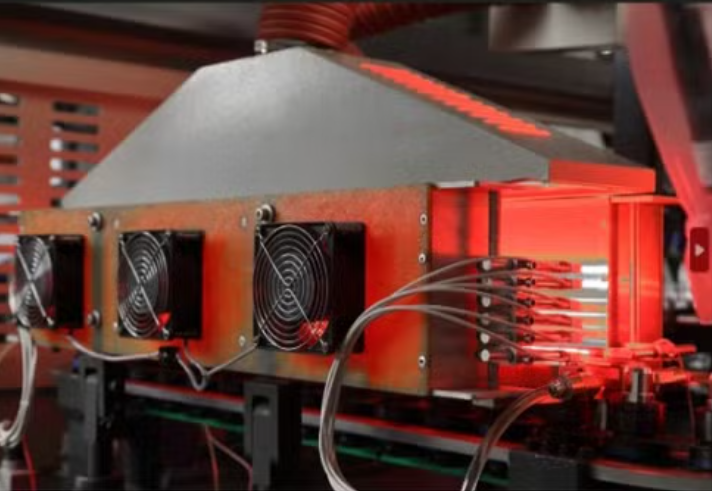
On the floor, a 5-gallon PET line lives and dies by the heating tunnel. If the preforms come out too cool, you get thin walls and blowouts. Run them too hot and they sag, stretch unevenly, and still blow out. When the IR emitter underperforms, you don’t just lose a few bottles—you lose rate, scrap resin, and the confidence that the machine will hold. We built our IR radiator for one job: heating 5-gallon PET preforms on stretch blow molders. Not a generic heater. A direct-fit replacement, laid out around the geometry and power density needed to hit the preform’s temperature window quickly—and keep it there.
What matters, technically
For 5-gallon PET preforms, the requirement is simple: deliver stable, controllable infrared energy into the preform wall without scorching the surface or leaving the core cold. We use short-wave infrared emitters with quartz envelopes. It comes down to physics and control. Short-wave IR penetrates the PET wall better than long-wave convection, and it responds fast when you change power. Quartz handles thermal shock and holds output steady in a tunnel where ambient temperature swings are just part of the day. The specs are chosen to match OEM heating-zone expectations:
- Power: 1.0–1.5 kW per emitter, depending on the blow molder’s zone layout and preform wall thickness.
- Voltage: 230 V or 400 V configurations to match the machine cabinet supply.
- Emitter length: sized to cover the preform body and shoulder without leaving cold bands.
- Termination: R7s connector interface—standard across many blow molders—so replacement is quick. In practice, that means a repeatable heat profile. On a typical 5-gallon run, the tunnel can reach and hold the required preform temperature within a tight band, so the blow station sees consistent material behavior cycle after cycle.
Why this works on 5-gallon
A 5-gallon PET bottle is a heavy part. The preform wall is thicker than a beverage preform, and it needs longer dwell in the heater to even out the temperature. When emitter output drifts, you often don’t see a catastrophic failure first. You see inconsistency: some preforms stretch too much, some too little, and the scrap rate climbs. This IR radiator tackles that in three ways. It matches the machine’s zone geometry. Spacing, length, and power density are engineered so the preform gets uniform energy across the body and shoulder—the same areas that define burst strength and handle integrity. It delivers repeatable output. We measure and document output stability over emitter life. In production, we’ve seen units hold output within a tight band for 5,000+ hours, with less than 5% drop. That kind of stability means fewer hours spent chasing the setpoint. It improves the energy balance of the tunnel. Short-wave IR heats the preform directly, not the surrounding air. So you can reach the required preform temperature with lower tunnel air temperature, which cuts overall energy draw. On many 5-gallon lines, that shows up as real kWh savings per shift. You also get faster recovery after changeovers. When you switch preforms, the heater comes back to the target profile quickly because the emitter response is fast. Less warm-up time equals more uptime.
What you need to know
Installation is straightforward on most blow molders, but there are real-world constraints to plan for. Reflectors matter. The emitter performs best with clean, properly aligned reflectors. If the reflector is pitted or out of position, you’ll get uneven heating even with a good emitter. Zone control has to match. The radiator must line up with the machine’s zone wiring, fusing, and thermocouple strategy. If the machine uses a specific control method, the replacement needs to be configured to the same parameters. The environment is harsh. The tunnel is hot, and airflow carries particulates. Keep the emitter and connector free of dust and resin buildup. High ambient temperature will shorten connector life if the connection is undersized or poorly seated. Watch the ends. The emitter ends run hotter than the center. Make sure the holder and insulation are in good shape; otherwise, you can damage components even if the emitter itself is fine. If you’re running 5-gallon PET on a stretch blow molder and the heating zone can’t hold a stable profile, a correctly matched IR radiator is a practical upgrade. No magic—just physics matched to the numbers your machine needs. Tell us the blow molder model, preform weight, and the existing emitter spec. We’ll give you the exact configuration that fits your tunnel, voltage, and cycle targets.