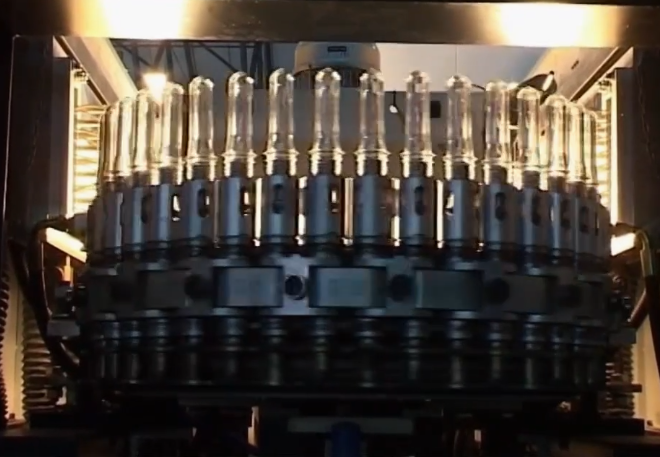
On the blow molding floor, a heating failure never picks a good moment. Preforms undershoot, and you’re making scrap. They overheat, and you get thin spots and stress cracks. Either way, the line slows down, and the heating tunnel starts calling the shots for the whole shift.
What matters, technically
We build replacement lamps to drop straight into Sidel blow molders—1:1 parameter alignment—and they cross-reference clean to Krones, SIPA, Husky, SACMI, and Nissei ASB heating systems. The specs are OEM-tight: 230 V or 460 V, 1,000–1,500 W, R7s base, and the arc length and envelope diameter exactly right. Pick short-wave halogen or medium-wave infrared emitters based on your preform wall thickness and cycle time. Fast thermal response cuts warm-up. Stable spectral output keeps the temperature window tight across the heating tunnel.
Why this matters in stretch blow molding
In stretch blow molding, repeatable heating is the difference between running at design speed and spending the shift chasing rejects. These lamps hold consistent output for 5,000+ hours, with output drift under 5%. Fewer lamp changes. Fewer interruptions. More predictable OEE. Energy use drops because the emitter puts heat where it belongs—on the preforms, not the machine frame. You end up with faster cycles, cleaner bottle geometry, and less rework.
The details that keep it running
Installation is straightforward, but you have to recalibrate the heating window after lamp replacement. Match wattage and voltage to the socket, check the reflector condition, and confirm thermocouple placement. **Keep the lamp surface clean.**Oils and dust create hot spots that kill lamps early. If your machine lives in a high-humidity washdown area, confirm the sealing rating, and let the quartz cool before you clean it.