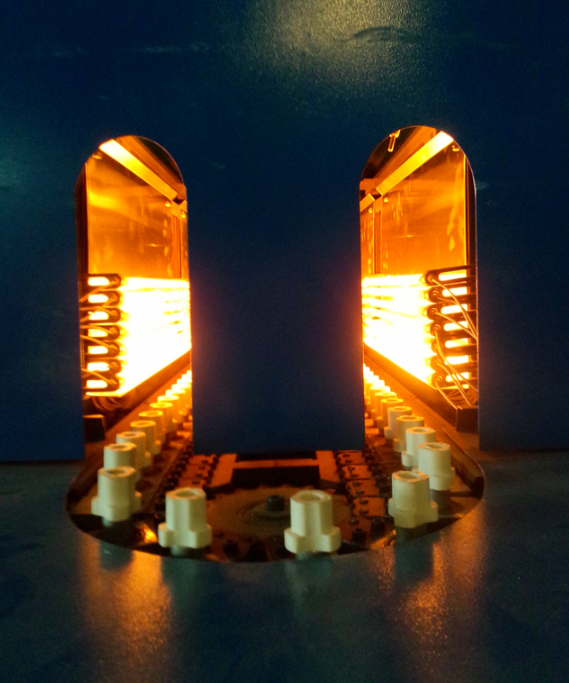
On the blow molding line, the oven is where the run either makes it or breaks it. Preforms that come out with a cool shoulder and a hot body make you chase stretch ratios all shift, and the bottles show it—stress lines, top load that drifts. What you need is heat that works with how the PET crystallizes, not just a hot element that glows. What matters under the hood We build the infrared lamp for blow molder ovens as a matched emitter: short-wave quartz halogen, tuned for fast, controllable surface heating that gets into the PET quickly without scorching. Filament layout and reflector geometry are set to give you a defined heat pattern across the preform, so the heating tunnel sees repeatable temperature distribution. Specs stay grounded in OEM fit: standard voltages (220V/240V), R7s base or custom terminals, and envelope lengths that clear tight oven chambers without fouling the conveyor or shielding. Every lamp is run-tested to a tight tolerance on output and warm-up response, then checked against a documented QC checklist. In stretch blow molding, the oven isn’t just heating—it’s conditioning. With the right infrared profile, preforms hit the correct stretch window faster. That cuts cycle time and trims energy per bottle. You see fewer rejects from uneven wall thickness, and less downtime chasing temperature drift. The lamps are built to OEM dimensional and electrical standards, so you can swap them in one-for-one on Sidel, Krones, SIPA, Husky, SACMI, and Nissei ASB machines, and get the original heating logic back without reworking the oven. Here’s the reality with infrared: it heats fast, so reflector cleanliness and alignment matter more than they did with older elements. Output will drift down a bit over time—plan replacements on a schedule so the profile stays stable. If your oven has variable zones, match lamp wattage to the zone profile. Mismatched wattages will skew the curve and hurt bottle consistency.