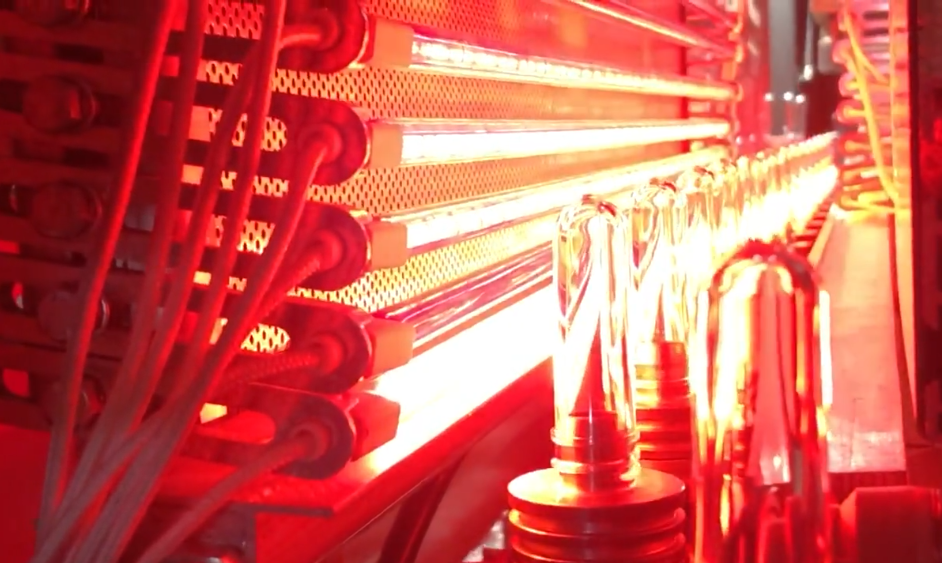
On a blow molding line, the heating tunnel is where everything starts. Preforms have to land in that tight temperature window, every cycle, without fail. If the heater goes down, the line stops—scrap climbs, oven temps wander, and you burn minutes you can’t get back.
What matters, technically
We build Teflon-insulated infrared heaters that have to live in the tunnel and still deliver repeatable heat. The conductor is nickel-chromium alloy, running in a quartz or ceramic body, with PTFE insulation rated for continuous exposure up to 260°C. In practice, that lets you run the high temperatures PET stretch blow molding demands without the insulation turning brittle. Each element is specified to match the OEM’s watt density, voltage, and geometry—typically 400–2,000 W, 100–240 V, and lengths that fit standard heating zones. Connections are done to standard terminals and R7s bases, so the element seats clean and transfers heat with minimal contact resistance.
Why it holds up in the tunnel
Here’s the truth: the only scoreboard that matters is uptime. Our heaters are dimensioned 1:1 to OEM drawings, so installation is straightforward on Sidel, Krones, SIPA, Husky, SACMI, and Nissei ASB machines. PTFE insulation handles the heat cycling and the ambient conditions that chew up cheaper jackets, which cuts down on unplanned changeouts. When the heater does its job, preform heating stays stable, blow-off is repeatable, and you stop seeing off-spec bottles. Energy use stays predictable, too, because the element delivers its rated wattage without drifting.
The shop-floor details you can’t skip
Match the mounting and termination exactly—misalignment creates hot spots and kills elements early. Keep the heater surface clean of dust and bottle residue; buildup reflects heat and drives uneven heating. PTFE is tough, but it has limits. Don’t exceed the rated insulation temperature, and avoid mechanical abrasion during handling. Stick to those basics, and you’ll get consistent output with fewer emergency stops.