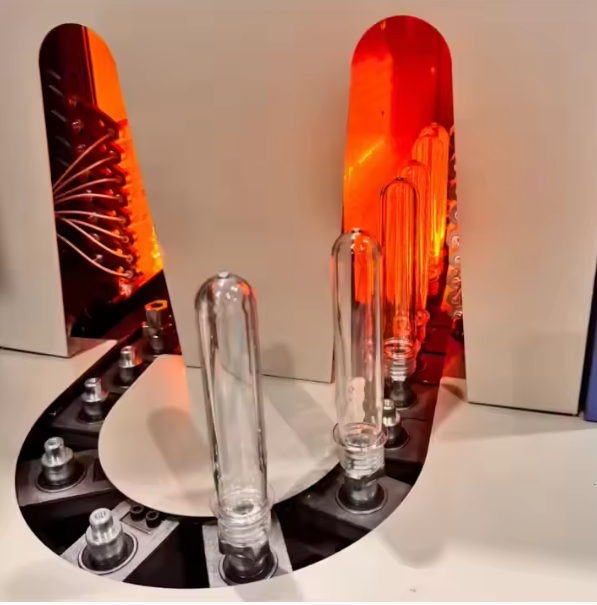
On the floor, a heating tunnel that’s drifting out of spec doesn’t throw a light or sound an alarm. You see it in the bottles—off spec—and in the scrap rate climbing. The operator ends up chasing the temperature band, trying to get the heat map back where it belongs. In stretch blow molding, the preform has to land in a tight window before the stretch rod even touches it. If the heat isn’t repeatable, nothing downstream is repeatable. What actually matters is the match between the emitter and what the machine needs from the heating zone. We run quartz infrared heater elements in short-wave and medium-wave profiles, built to standard dimensions and proven connector types. The specs are engineered to OEM tolerances—length, diameter, and focal distance held consistently, with R7s and other common terminations. We match power density to the heating zone so the preform surface heats fast without scorching, and we hold output stability over thousands of hours. In practice, that translates to less drift, fewer parameter tweaks, and a heating curve you can count on shift after shift. Compatibility is the part that earns trust. These quartz heaters drop straight into Sidel Matrix, Krones Contiform, and Husky HyPET platforms, and into SIPA and SACMI lines—1:1 dimensional and electrical fit. Direct replacement means changeover stays quick, change parts stay simple, and downtime stays minimal. You end up with more consistent wall thickness, better weight control, and fewer rejects caused by uneven heating. Energy use comes down because the heaters come up fast and hold steady. Maintenance gets easier when you can standardize on a single, reliable element across multiple blow molders. A practical heads-up: quartz infrared emitters are sensitive to handling and contamination. Clean the connections, don’t touch the quartz tube, and double-check mounting geometry and reflector alignment. Match voltage and power to the machine’s spec, and confirm the heating zone profile before you run full production. Keep spares on hand and rotate them on schedule. Do that, and the tunnel stays in control, the bottles stay in spec, and the line keeps running.